Author: tuki

  • A head start for the forerunners in electricity derivatives hedging

    A head start for the forerunners in electricity derivatives hedging

    A significant share of Nordic electricity derivatives trading already occurs bilaterally. In recent years, exchange-traded volume has fallen by about one-third, while bilateral trade volume has nearly doubled.

    “The reasons for this shift include the energy crisis, daily cash settlement of futures, tighter regulation, limited supply from Nordic clearing banks, and long-term renewable energy PPAs. The question is why only a few players have benefited from a changing market, and how market participants can turn the situation to their advantage,” says Suvi Paaso, CEO of Power-Deriva.

    Suvi Paaso

    Power-Deriva’s CEO, Suvi Paaso, is shaping the future of electricity derivatives trading.

    PD Port: Your platform for profitable bilateral electricity derivatives trading

    According to a Fingrid study, bilateral electricity derivatives trading is largely conducted by large and state-owned entities. As a result, smaller operators have had no visibility of actual price levels and have been unable to benchmark prices effectively. Finding counterparties has also been a challenge.

    PD Port changes the dynamic: Licensed by the Finnish Financial Supervisory Authority, PD Port is a marketplace for bilateral electricity derivatives, where market participants can view open bids and market interest in a single view. Trading is possible between counterparties under an existing framework agreement.

    “PD Port is set to transform bilateral derivatives trading. We are increasing transparency and helping market participants manage contracts and counterparty risk. By mid-May 2026, PD Port had secured 11 letters of intent, and change is underway,” says Paaso.
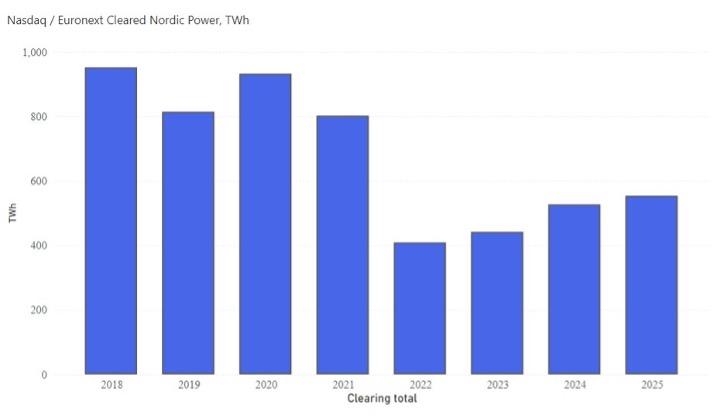
    Sähkönjohdannaiskaupan muutos vuosina 2018–2025.

    The transformation of electricity derivatives trading, 2018–2025.

    What the forerunners in electricity derivatives trading have to say

    Turku Energia‘s interest in PD Port was sparked by persistently weak liquidity in electricity derivatives trading based on regional price differences. Hedging against regional price spreads is particularly challenging because the number of market participants in each area is typically small. Finland currently has just one price area, which helps, but Sweden and Norway, for instance, have several. Turku Energia is also concerned about the broader decline in liquidity in derivatives trading. Time will tell whether the shift in liquidity in the electricity derivatives market is permanent.

    “Transparency is a prerequisite for a competitive market. Everyone benefits from effective price hedging, consumers included. It’s great to be involved in developing PD Port through an active forum, and to have our views genuinely heard,” says Ari Lahti, Portfolio Manager at Turku Energia.

    For Oomi, hedging is at the core of its business, with fixed-price electricity contracts hedged using derivatives. The company, which serves more than 800,000 residential and business customers, has been a Power-Deriva partner for years.

    “Power-Deriva has built the platform with real thought behind it. They actively seek our input and develop the service alongside us. We’re excited to play a part in shaping PD Port’s development. I believe the new marketplace will make a portfolio manager’s day-to-day work significantly easier,” says Antti Tammi, Trading & Portfolio Development Lead at Oomi.

    Alongside numerous sales and generation companies, a major Nordic energy-sector integrator is also working to advance transparent and efficient trading in bilateral electricity derivatives.

    “This particular player’s annual trading volume amounts to tens of terawatt-hours,” Paaso notes.

    Why now is the right time to join PD Port

    Players who come on board early will have the opportunity to shape the platform’s development through the Customer Advisory Board, to establish framework agreements, and to secure a position one step ahead of the rest.

    “PD Port is a shared opportunity for the entire energy market. The snowball has started rolling,” says Paaso.

    Joining the PD Port marketplace begins with a letter of intent, after which participants can expand their counterparty network and stay up to date with PD Port’s developments via a newsletter. Power-Deriva can support parties with contract negotiations and, once PD Port is operational, provide counterparty risk management as a separate service. The product range covers baseload, EPAD, SYS, and combo products, with a minimum of 0.1 MW, available on monthly, quarterly, and annual terms across the Nordics and the Baltics. Membership fees start at €250 per month, with a volume fee of €0.036/MWh.

    “There’s also a financial incentive for the fastest movers: a letter of intent signed by 1 November 2026 entitles the signatory to a 35% discount for the first six months after PD Port launches,” Paaso promises.

    Join PD Port by 1 November 2026 to get 35% off your first six months.

    Book a meeting or get in touch.

    Let’s map out your opportunities:

  • Maximizing wind power value through energy market mastery

    Maximizing wind power value through energy market mastery

    Suomen Hyötytuuli Oy, founded in 1998, is one of Finland’s largest wind power companies, with a generation capacity of 654 MW. The company operates ten wind farms across Finland, including sites on the west coast, in North and Central Ostrobothnia, and in Pori, which is home to Finland’s only offshore wind farm. The company is owned by Oy Mankala Ab, Vantaan Energia, Tampereen Energia, Turku Energia, Lahti Energia, Lappeenrannan Energia, Alva-yhtiöt (Jyväskylä) and Pori Energia.

    “The wind power market is evolving rapidly. Finland’s wind power capacity is approaching 10 GW. Electricity prices remain competitive by European standards, and renewable power has a significant impact on the market,” says Ristomatti Lummikko, Director of Energy at Suomen Hyötytuuli.

    In spring 2026, Suomen Hyötytuuli was preparing to take on a new role in the energy market. The company decided to take responsibility for its own balance management and electricity trading to further develop its electricity market operations. Its strategic objective, rooted in the company’s values, was to remain a frontrunner in the industry.

    “When we became a market participant, every process related to electricity trading—from data communications and system integrations to contracts—had to be redesigned or built from scratch,” says Miia Suuriniemi, Development Manager at Suomen Hyötytuuli, who led the transformation project.

    Suomen Hyötytuuli’s Development Manager Miia Suuriniemi and Director of Energy Ristomatti Lummikko are satisfied with the project’s efficient implementation.

    Driving a productivity leap in wind power generation

    Renewable energy producers must respond immediately to market price signals. Effective balance management is a critical success factor, and maximizing production value requires continuous participation in the most profitable market. This demands a fully automated, real-time operational environment that integrates trading, automation, reporting, and balance management. Suomen Hyötytuuli selected Power-Deriva as its partner following a competitive tendering process. Power-Deriva’s extensive experience and broad range of services made the company the ideal partner for the project.

    The starting point was challenging. Processes used by wind farm operators, commercial counterparties, and forecasting service providers needed to be integrated into a single workflow. The Mankala model, which allocates costs and revenues by ownership, was implemented across ten wind farms, eight owner companies, and multiple share classes. Reporting and billing required specialized expertise, and personnel had to adapt to new models.

    The project was equally significant for Power-Deriva.

    “We had previous experience with wind power projects, but the scale of this project was on a completely different level. The timeline was demanding, so we got to work immediately,” says Mika Laakkonen, CEO of PD Power Oy.

    How a wind power producer became a market participant

    In the process developed by Power-Deriva, forecasts and realised market prices direct trading to the most profitable market at any given time. This generates a real-time control signal for wind farm automation.

    The service package includes Day-Ahead (DA) price forecasting, reserve market trading, algorithm-based Intraday (ID) trading, multi-market optimization, balance settlement, reporting, shareholder billing, and system services. Power-Deriva’s 24/7 control room in Harjavalta monitors the operations.

    Main project phases:

    • Market participant implementation: The project began by defining Suomen Hyötytuuli’s new role as a direct market participant, establishing the required commercial interfaces with electricity exchanges, and concluding balance responsibility agreements with Fingrid.
    • Real-time data integration: Suomen Hyötytuuli’s systems were integrated with trading platforms and production control systems, enabling real-time data exchange in line with market schedules.
    • Multi-market optimisation and automation deployment: The system forecasts prices and production, selects the most profitable market using algorithms, automates trading and sends real-time control signals to wind farms. Balance settlement, reporting and billing are also automated.
    • Mankala reporting and shareholder billing: Power-Deriva developed a reporting and calculation model covering ten wind farms, eight owner companies, all share classes, and the cost and revenue allocation of the Mankala structure.
    • 24/7 control room: Power-Deriva’s control room in Harjavalta monitors trading, production and markets around the clock.

    “Working with Power-Deriva has been straightforward. We described the challenge, and Power-Deriva came up with a solution,” Lummikko says.

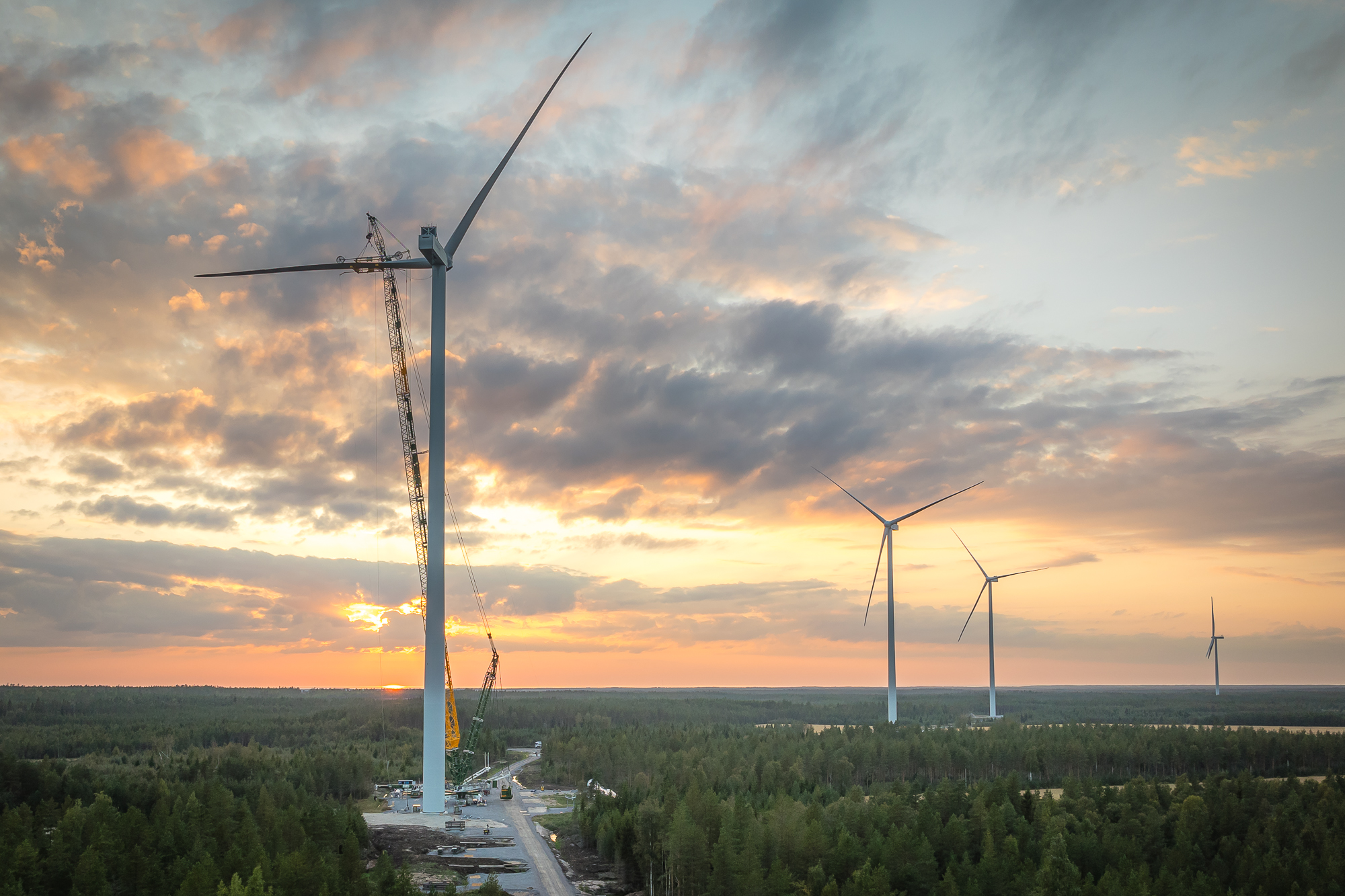
    Alajoki-Peuralinna (Image: Suomen Hyötytuuli Oy)

    Taking control of energy market operations in three months

    As a result of the project, Suomen Hyötytuuli achieved full market-driven operation, enhanced balance management capabilities and an independent role in the electricity market. Algorithm-based trading now operates around the clock, multi-market optimisation maximises the value of wind power production, and balance management has improved significantly. Mankala reporting and shareholder billing are handled automatically. As forecasts change, wind power sales can be redirected between markets, with price and production forecasts determining the most profitable market at any given time. The entire trading chain, from forecasting to settlement, is automated, allowing Suomen Hyötytuuli to focus on producing wind power while trading operations run seamlessly in the background.

    “Power-Deriva is responsible for the operational management of electricity trading. Based on the trading outcome, a control signal is generated and transmitted to the wind farms’ control systems. Our responsibility covers the commercial side of trading and the generation of the control signal, while a third party is responsible for the wind farms’ control systems and automation,” says Maria Vehmaan-Kreula, Application Specialist at Power-Deriva.

    “From an implementation standpoint, the greatest achievement was delivering the project on such a tight schedule. Becoming a Balance Responsible Party (BRP) was one of the most significant transformations in our company’s history,” says Suuriniemi.

    The project was a valuable learning experience for both organisations. Perhaps the most significant insight was that effective balance management is vital to the success of wind power generation. Wind conditions do not align with market schedules, and any imbalance affects profitability.

    “I have learned a great deal throughout the project, and so has the rest of our organisation. Our next areas for development include refining our trading strategy and making even better use of reserve markets,” Lummikko says.

    “This is only the beginning of the story,” Laakkonen concludes.

    Article images: Suomen Hyötytuuli Oy

    Key customer benefits

    • Algorithms optimize the value of wind power generation in real time.
    • Improved balance management reduces imbalance costs from forecast errors and improves profitability.
    • Automated trading, reporting, and billing save time and money while reducing manual errors.
    • Successful implementation of a major operational transformation in three months.
    • Close collaboration during implementation and ongoing development ensures that solutions meet evolving business needs.

  • Strategic hedging brings peace of mind: How to succeed with Energy Manager™

    Strategic hedging brings peace of mind: How to succeed with Energy Manager™

    The electricity market moves in real time: prices fluctuate, risks rise, and decisions must be made faster than ever. Managing price risk has therefore become a critical part of business steering. In day-to-day supply and production management, clear signs of a lack of strategic hedging include manually updated Excel sheets, fragmented data, and uncertainty about budgets, positions, and hedging. 

    – Without a centralized system, hedging decisions and the resulting financial outlook rely on guesswork, fragmented data, and manual calculations, says Jani Rasilainen, Head of Portfolio Management and Trading Services at Power-Deriva. 

    A real-time view eliminates blind decisions. 

    Power-Deriva’s Energy Manager™ risk management system turns electricity price hedging into a strategic management tool. It brings positions, risks, and market scenarios into a single view without manual effort, integrating production, sales, hedging, and market prices. The system also automatically retrieves the latest exchange closing prices and updates calculations. 

    The key benefit of Energy Manager™ is transparency: at a glance, you can see how much of the position is hedged and what level of risk remains at any given moment. 

    – For example, at the monthly level, you can clearly see the sales forecast, the hedged share, and the portion exposed to market price changes. This allows hedging to be timed correctly, risks to stay under control, and the business to be managed systematically, even in uncertain market conditions, Rasilainen emphasizes. 

    Scenarios and analytics as the context for decision-making 

    In a changing energy market, the status quo is no longer enough. Energy Manager™ combines real-time data with price modeling from Power-Deriva’s analytics team, incorporating dozens of scenarios based on factors such as renewable generation, weather conditions, and market dynamics—extending the forecast years, even decades, into the future. The system shows how different price levels affect financial performance across best-case, worst-case, and most likely scenarios, allowing risk to be quantified in euros. 

    – For example, if the median scenario indicates higher prices ahead, hedging can be postponed. Conversely, when the market weakens, the system guides users to increase hedging. In this context, the key question is timing optimization, not just managing the hedging ratio, Rasilainen explains. 

    How to balance risks and returns in the energy market 

    For energy companies and large electricity consumers, business is not a straightforward calculation based solely on spot prices. That’s why Energy Manager™ considers different production types, contract structures, and their specific characteristics. 

    – For example, actual wind power revenue often differs from the spot price, and the system can account for this in its calculations. Similarly, sales agreements, such as consumption-based and partially fixed contracts, are modeled accurately. This improves forecast reliability and enables portfolio-level optimization rather than focusing on individual trades, Rasilainen notes. 

    From budgeting and risk management to a steering model 

    Most importantly, Energy Manager™ ensures that electricity price hedging aligns with overall business objectives. The system integrates budgeting into decision-making through continuously updated profit forecasts and clearly signals when performance deviates from the budget. 

    – Energy Manager™ is a solution for balancing risk and return. It helps companies move from reactive trading to a predefined, disciplined hedging strategy—in other words, to more profitable business operations, Rasilainen concludes. 

    How Energy Manager™ saves time, reduces costs, and improves control: 

    • Combines budgeting and risk management into a unified steering model 
    • Provides real-time visibility into positions, risks, and financial impacts 
    • Automatically updates market data without manual effort 
    • Enables scenario-based analysis to support decision-making 
    • Uses accurate calculation models for different production and contract structures 
    • Improves hedging timing and decision-making consistency


    Want to understand how your company’s risk position is evolving? Get in touch.

  • The Power Derivatives Market is Evolving—PD Port helps you hedge prices

    The Power Derivatives Market is Evolving—PD Port helps you hedge prices

    In spring 2026, trading in power derivatives will be split between Euronextand EEX. While the new clearing model may bring stability to the market, it also makes it increasingly difficult—especially for smaller operators—to ensure the profitability of price hedging. We acted and started building a marketplace where trusted participants meet and trade power derivatives. Learn what PD Port is all about and how you can get involved. 

    Winds of Change in the Nordic Power Derivatives Market 

    Nasdaq’s power derivatives trading will move to a market operated by Euronext on March 14, 2026. A test phase with a limited product offering will begin on February 2. From March onwards, Nordic power derivatives will therefore be traded on two separate power derivatives exchanges: Euronext and EEX.  

    We are following with great interest where trading activity will ultimately concentrate and where supply and demand will meet. In the second half of 2025, EEX strengthened its position by offering incentives such as one year of trading without transaction fees. Will EEX succeed in attracting participants to its Nordic power derivatives market by investing in regional liquidity, or will Nasdaq members migrate to Euronext?  

    Most importantly, the reforms bring several changes that require particular attention from small and mid-sized energy market participants.  

    Trading volumes of Nasdaq’s Nordic power derivatives products, 2014–2025. In 2025, volumes totaled 496 terawatt-hours.  

    In 2025, trading volumes for EEX’s Nordic power derivatives products (approximately 0–3 TWh per month) were lower than those for Nasdaq’s Nordic power derivatives (approximately 40–60 TWh per month). 

    A New Membership Model and Volume Constraints Challenge Nordic Market Participants

    Going forward, trading on both the Euronext and EEX power derivatives exchanges—as well as clearing through central counterparties (CCPs)—will require a GCM membership model. Under this model, a General Clearing Member (GCM), typically a bank, acts as an intermediary between the energy market participant and the exchange’s clearing function and assumes the counterparty risk.

    From the perspective of Nordic energy market participants, it is also significant that Nasdaq’s Direct Clearing Client (DCC) membership model, in place for over 20 years, will be discontinued. In exchange trading, an individual direct member can represent a substantial counterparty risk to the clearing house. While the GCM model enhances stability in exchange trading through regulated, well-capitalized banks, it may also make market access more difficult for smaller energy market participants due to credit requirements or rising operational costs. In addition, GCM services are currently offered by only one Nordic provider.

    To hedge profitability, the most significant change is that the minimum cleared contract size will increase to 1 MW, up from 0.1 MW previously used on Nasdaq. For example, a company consuming approximately 300 gigawatt-hours of electricity per year has an average power demand of around 35 megawatts, making a one-megawatt contract disproportionately large. As a result, it becomes more challenging to stagger hedges over time and to fine-tune hedging to match the consumption profile.

    Bilateral Hedging–a Shared Reality for Market Participants

    There are approximately 360 electricity retailers in the Nordic region, of which only around five are large players. In other words, the majority are smaller participants for whom hedging electricity price risk is essential for business planning and predictability. In addition, ongoing changes in the physical wholesale electricity market and reserve markets are bringing a growing number of renewable energy producers, flexible generation assets, and electricity consumers—such as data centers—into the market. These participants must be able to anticipate and manage their financial performance over time.

    As noted in a 2024 study by Fingrid, the market for bilateral derivatives contracts is an oligopoly, with a small number of large players controlling a significant share of trading. Are power derivatives truly effective instruments for small and mid-sized participants, or do recent reforms steer them toward bilateral trading with only a few large counterparties? How can price transparency and reasonable transaction costs be ensured?

    Bilateral derivatives trading is here to stay. Market participants no longer hedge electricity prices solely through exchange-traded products, and some rely entirely on bilateral derivatives contracts. At the European level, bilateral power derivatives trading increased from 10% at the beginning of 2022 to 30% by the end of 2023. Based on ESMA data through 2023, this growth has been robust among energy market participants, and trading volumes in 2025 suggest that this trend will continue.

    How PD Port Addresses the Challenges of the Power Derivatives Market

    In practice, executing bilateral power derivatives trades is often easier said than done. Finding suitable counterparties and competitively pricing transactions can be complex, risky, and time-consuming. At the same time, tightening regulationsincreases complexity and administrative burden. The key question is how to build an accessible, secure, and transparent way for all market participants to hedge electricity price risk.

    We decided to build PD Port—a new kind of marketplace where trusted participants can meet and competitively price power derivatives. As a neutral market operator, we provide an independent platform that connects counterparties, enhances liquidity, and makes trading simpler, fairer, and more reliable:

    • When prices, terms, and counterparties are openly visible, price formation is driven by genuine supply and demand rather than hidden margins or one-sided contract terms.  
    • Transparency reduces information asymmetry, builds trust, and supports counterparty risk management by allowing participants to assess counterparties and terms before committing.  
    • The trading process becomes more efficient: manual work is reduced, and bids and offers can reach multiple counterparties simultaneously.  
    • Open competition improves outcomes for smaller participants as well—particularly those for whom exchange collateral requirements and administrative costs can be a barrier.  

    PD Port combines the flexibility of customized power derivatives contracts with the discipline of a transparent marketplace. It supports regulatory compliance and strengthens overall market resilience by distributing risk across a broader set of participants. With market information openly available and subject to regulatory oversight, the market remains safe, fair, and transparent. A new era of responsible power derivatives trading has begun.

    Learn more about PD Port: Port | Power-Deriva Oy

    Get in touch and join us in shaping a new market standard.

    • Tatu Lipsanen

      +358 50 553 6664
      firstname.lastname@power-deriva.com

    • Suvi Paaso

      +358 50 453 6054
      firstname.lastname@power-deriva.com