Category: News

  • The Power Derivatives Market is Evolving—PD Port helps you hedge prices

    The Power Derivatives Market is Evolving—PD Port helps you hedge prices

    In spring 2026, trading in power derivatives will be split between Euronextand EEX. While the new clearing model may bring stability to the market, it also makes it increasingly difficult—especially for smaller operators—to ensure the profitability of price hedging. We acted and started building a marketplace where trusted participants meet and trade power derivatives. Learn what PD Port is all about and how you can get involved. 

    Winds of Change in the Nordic Power Derivatives Market 

    Nasdaq’s power derivatives trading will move to a market operated by Euronext on March 14, 2026. A test phase with a limited product offering will begin on February 2. From March onwards, Nordic power derivatives will therefore be traded on two separate power derivatives exchanges: Euronext and EEX.  

    We are following with great interest where trading activity will ultimately concentrate and where supply and demand will meet. In the second half of 2025, EEX strengthened its position by offering incentives such as one year of trading without transaction fees. Will EEX succeed in attracting participants to its Nordic power derivatives market by investing in regional liquidity, or will Nasdaq members migrate to Euronext?  

    Most importantly, the reforms bring several changes that require particular attention from small and mid-sized energy market participants.  

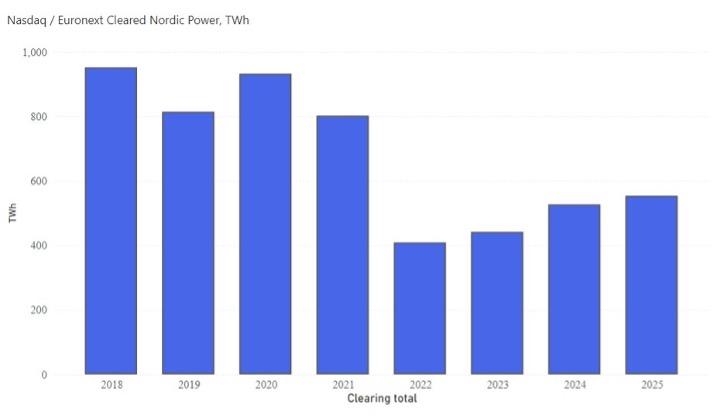
    Trading volumes of Nasdaq’s Nordic power derivatives products, 2014–2025. In 2025, volumes totaled 496 terawatt-hours.  

    In 2025, trading volumes for EEX’s Nordic power derivatives products (approximately 0–3 TWh per month) were lower than those for Nasdaq’s Nordic power derivatives (approximately 40–60 TWh per month). 

    A New Membership Model and Volume Constraints Challenge Nordic Market Participants

    Going forward, trading on both the Euronext and EEX power derivatives exchanges—as well as clearing through central counterparties (CCPs)—will require a GCM membership model. Under this model, a General Clearing Member (GCM), typically a bank, acts as an intermediary between the energy market participant and the exchange’s clearing function and assumes the counterparty risk.

    From the perspective of Nordic energy market participants, it is also significant that Nasdaq’s Direct Clearing Client (DCC) membership model, in place for over 20 years, will be discontinued. In exchange trading, an individual direct member can represent a substantial counterparty risk to the clearing house. While the GCM model enhances stability in exchange trading through regulated, well-capitalized banks, it may also make market access more difficult for smaller energy market participants due to credit requirements or rising operational costs. In addition, GCM services are currently offered by only one Nordic provider.

    To hedge profitability, the most significant change is that the minimum cleared contract size will increase to 1 MW, up from 0.1 MW previously used on Nasdaq. For example, a company consuming approximately 300 gigawatt-hours of electricity per year has an average power demand of around 35 megawatts, making a one-megawatt contract disproportionately large. As a result, it becomes more challenging to stagger hedges over time and to fine-tune hedging to match the consumption profile.

    Bilateral Hedging–a Shared Reality for Market Participants

    There are approximately 360 electricity retailers in the Nordic region, of which only around five are large players. In other words, the majority are smaller participants for whom hedging electricity price risk is essential for business planning and predictability. In addition, ongoing changes in the physical wholesale electricity market and reserve markets are bringing a growing number of renewable energy producers, flexible generation assets, and electricity consumers—such as data centers—into the market. These participants must be able to anticipate and manage their financial performance over time.

    As noted in a 2024 study by Fingrid, the market for bilateral derivatives contracts is an oligopoly, with a small number of large players controlling a significant share of trading. Are power derivatives truly effective instruments for small and mid-sized participants, or do recent reforms steer them toward bilateral trading with only a few large counterparties? How can price transparency and reasonable transaction costs be ensured?

    Bilateral derivatives trading is here to stay. Market participants no longer hedge electricity prices solely through exchange-traded products, and some rely entirely on bilateral derivatives contracts. At the European level, bilateral power derivatives trading increased from 10% at the beginning of 2022 to 30% by the end of 2023. Based on ESMA data through 2023, this growth has been robust among energy market participants, and trading volumes in 2025 suggest that this trend will continue.

    How PD Port Addresses the Challenges of the Power Derivatives Market

    In practice, executing bilateral power derivatives trades is often easier said than done. Finding suitable counterparties and competitively pricing transactions can be complex, risky, and time-consuming. At the same time, tightening regulationsincreases complexity and administrative burden. The key question is how to build an accessible, secure, and transparent way for all market participants to hedge electricity price risk.

    We decided to build PD Port—a new kind of marketplace where trusted participants can meet and competitively price power derivatives. As a neutral market operator, we provide an independent platform that connects counterparties, enhances liquidity, and makes trading simpler, fairer, and more reliable:

    • When prices, terms, and counterparties are openly visible, price formation is driven by genuine supply and demand rather than hidden margins or one-sided contract terms.  
    • Transparency reduces information asymmetry, builds trust, and supports counterparty risk management by allowing participants to assess counterparties and terms before committing.  
    • The trading process becomes more efficient: manual work is reduced, and bids and offers can reach multiple counterparties simultaneously.  
    • Open competition improves outcomes for smaller participants as well—particularly those for whom exchange collateral requirements and administrative costs can be a barrier.  

    PD Port combines the flexibility of customized power derivatives contracts with the discipline of a transparent marketplace. It supports regulatory compliance and strengthens overall market resilience by distributing risk across a broader set of participants. With market information openly available and subject to regulatory oversight, the market remains safe, fair, and transparent. A new era of responsible power derivatives trading has begun.

    Learn more about PD Port: Port | Power-Deriva Oy

    Get in touch and join us in shaping a new market standard.

    • Tatu Lipsanen

      +358 50 553 6664
      firstname.lastname@power-deriva.com

    • Suvi Paaso

      +358 50 453 6054
      firstname.lastname@power-deriva.com

  • Keeping Hydropower in the Flow: Ounastuotanto and Power-Deriva in Cooperation

    Keeping Hydropower in the Flow: Ounastuotanto and Power-Deriva in Cooperation

    Power-Deriva is responsible for the planning and control of Ounastuotanto’s hydropower plants and regulation reservoirs, as well as electricity trading and forecasting. The collaboration delivers measurable benefits in productivity, energy efficiency and resource efficiency.

    Ounastuotanto Oy is an energy production company owned by municipalities in Northern Finland. It has a long history and a broad portfolio of carbon-free energy sources. In addition, an industrial-scale battery system is being planned. Batteries react to changes in the electricity grid within seconds, making them ideal for short-term balancing and managing peak loads. Hydropower, in turn, provides long-lasting and flexible balancing capacity. Together, they enable efficient market optimization, agile use of renewable energy, and risk diversification.

    Outsourcing for Efficiency and Performance

    Maximizing productivity and succeeding in the energy market requires expertise and resources from hydropower plants. Previously, production was guided mainly by annual water volume—today, it must adapt to a more complex market with numerous variables and price fluctuations. No relief is in sight, as the Day-Ahead market is also shifting from hourly pricing to 15-minute intervals. To take control of the situation, Ounastuotanto decided to seek a skilled partner.

    Timo Virikko
    Timo Virikko, CEO of Ounastuotanto

    “With limited resources, doing everything ourselves is impossible. We chose Power-Deriva as our partner because they have strong credentials and extensive experience optimizing hydropower production in the energy market. With their support, our market window is always open,” says Ounastuotanto’s CEO Timo Virikko.

    A Robust and Streamlined Service

    Ounastuotanto’s hydropower production is optimized 24/7 in Power-Deriva’s control room, using real-time market data and forecasts. The service includes production planning for the next Day-Ahead (DA) period, as well as trading on the power exchange and in reserve markets. According to Power-Deriva’s experience, even smaller plant portfolios can have significant revenue potential in reserve markets.

    Ownership and administration of the production control system remain with Ounastuotanto. Power-Deriva operates the plants remotely in accordance with the agreed service model. The operating approach is flexible and secure, and Ounastuotanto can take control whenever needed.

    “Power-Deriva’s remote desktop solution effectively connects outsourced expert services with our system,” Virikko notes.

    Measurable Value and Efficiency

    The cooperation with Power-Deriva brings Ounastuotanto continuous operational and financial benefits. Outsourced production control and electricity trading with forecasts maximize plant revenue, minimize losses and stabilize operations, all without tying up Ounastuotanto’s own resources. The partnership brings welcome predictability and peace of mind, while enabling the team to focus on its core expertise: producing clean energy.

    “The energy market is constantly changing, but we trust that Power-Deriva keeps pace and helps set the direction. For an operator like us, this service package is a godsend,” Virikko says.

    “Our cooperation has started smoothly, and we are committed to being worthy of that trust. It is a privilege to apply our expertise in hydropower optimization and the electricity market for the benefit of the customer,” concludes Mika Laakkonen, CEO of PD Power Oy. 

    Customer Benefits in Brief:

    • Productivity and energy efficiency: production control and power trading are based on real-time market data and reliable forecasts.
    • A secure and reliable operating model: Ounastuotanto retains complete control of its systems.
    • Resource efficiency: Ounastuotanto can focus on producing clean energy.


    The graph shows the price differences between the mFRR regulation market and the DA market: The blue bars show, on average, how much more revenue could have been generated by selling electricity reserves on the mFRR energy market. The yellow bars show how much cheaper electricity could have been purchased.

  • How to Make the Right Moves in the Coming Winter´s Electricity Market

    How to Make the Right Moves in the Coming Winter´s Electricity Market

    Although Nordic water reservoirs sit at normal levels and early winter is expected to be mild, it’s once again wise to prepare for sharp electricity price fluctuations—especially if renewable energy production falls short. Our experts explain how you can turn the situation to your advantage.

    In the Nordics, weather fluctuates just as much as electricity prices do. Along the coasts of Norway and Sweden, the sea moderates temperatures, yet annual rainfall varies significantly. In Finland, maritime and continental climates meet: Atlantic low-pressure systems bring warm, wet air from the west, while high-pressure systems from the east bring cold, dry conditions. Still, temperature is only the tip of the iceberg when it comes to electricity pricing.

    “Electricity is typically cheaper in summer than in winter, but there are exceptions. For example, in August 2025, prices in Finland were high as several nuclear power plants were undergoing maintenance simultaneously. If winter is milder and windier than usual, prices may drop. The level of water reservoirs, wind conditions, sunshine, and global events all play a role,” notes Senior Analyst Antti Martikainen.

    Electricity prices are driven by many factors, whose combined effects become especially pronounced during winter and with the rise of quarter-hour pricing. The most tremendous volatility is seen within the day.
    “Winter can catch the power market off guard just as easily as it does road traffic. Still, the goal isn’t to fear the worst—it’s to prepare as well as possible,” emphasizes Portfolio Manager Ilari Kosonen.

    Small Differences, Big Impacts—for Better or Worse

    Electricity price fluctuations have a significant impact on both energy companies and the industry. For example, a €10/MWh price increase can amount to about €75,000 in additional monthly costs for a company with 10 MW of consumption. For larger industrial players using 20 MW, the impact doubles to €150,000 per month.
    “On the other hand, the earning potential is just as substantial. The question is whose forecasts are the most accurate, and how effectively can that information be applied; day to day, week to week, and month to month,” Kosonen says.

    Key Risk Factors in the Power Market

    Electricity trading involves several types of risks: market price, volume, balancing power, and profile risks:

    • Market price risk increases as renewable energy expands. Wind, solar, and hydropower output varies with weather, highlighting the need for effective hedging. These risks can be managed with derivatives such as Nasdaq futures and options, or bilateral agreements. When hedged correctly, market price risk can theoretically be eliminated.
    • Volume and balancing power risks arise when actual electricity consumption or production differs from the forecast used for purchasing, selling, or hedging. For example, if a company has hedged 10 MW but cold weather increases consumption to 12 MW, the additional 2 MW must be bought, often at a higher price. Conversely, in an oversupply situation, if hedges were purchased below the spot price, the surplus can even create profit.
    • Volume risks can be managed by distinguishing between temperature-dependent and independent consumption, using options to hedge flexibility, and keeping forecasts up to date. For instance, if an industrial plant is expected to consume 10 MW the next day but must shut down due to a production issue, it can sell the unused electricity back to the market at the best available price.
    • Balancing risks are common in weather-dependent production and consumption assets, often resulting in additional costs. Accurate day-ahead production and consumption forecasts are crucial. Updated forecasts and active intraday trading significantly reduce weather-related balancing risks.
    • Profile risks relate to how consumption aligns with hourly price variations. Electricity prices can swing sharply within a single day—low at night and significantly higher during afternoon peaks. For companies, the key is how well their usage matches expensive or inexpensive hours. These risks can be reduced with profile hedges and load shifting. An industrial company, for example, can purchase power in advance for hours when production peaks, requiring precise monitoring and real-time market insight. For electricity retailers, fluctuating spot prices introduce a new complexity as customers increasingly shift their consumption. Through detailed analysis, retailers can create flexible price bids for the day-ahead market, ensuring consumption forecasts adjust to demand response and reducing balancing risks.

    Power Market Management as a Service

    Managing the power market requires resources, expertise, and real-time data. For many companies, the optimal solution is to outsource to a Portfolio Manager who monitors the market, analyzes risks, and ensures operations remain under control.

    “At Power-Deriva, the only responsibility left to the customer is decision-making. They can also authorize the Portfolio Manager to make decisions on their behalf,” Kosonen explains.

    Cooperation with Power-Deriva begins with an assessment of the current situation, budget, and objectives — including key consumption and production figures and financial targets. The Portfolio Manager then creates a concrete action plan for hedging and trading across different power markets. The plan is based on the EMPS (EFI’s Multi Area Power-Market Simulator) model.

    “With EMPS, we can calculate the impacts and risk levels of different market scenarios. The model includes extensive weather and production scenarios and accounts for power plants, transmission capacities, and renewable energy sources. We use more than 40 years of weather and production data, as well as fuel price tracking, adjusted for future conditions,” Martikainen says.

    Once the service is running, Power-Deriva’s systems provide the customer with a real-time situational picture. Automation integrates profit and position analytics, tracks market developments, and can execute trades on the customer’s behalf. The service can include consumption forecasting, cost optimization, and minimization of balancing errors.

    “Ultimately, it’s essential to find a Portfolio Manager you can trust. Power-Deriva’s strengths include our proprietary modelling system, supervision by the Finnish Financial Supervisory Authority, over 20 years of experience in the power market, and numerous long-term customer relationships. We’ve seen many crises and learned from all of them,” Kosonen concludes.

    • Ilari Kosonen

      +358 45 113 0844
      firstname.lastname@power-deriva.com

    • Antti Martikainen

      +358 50 467 3575
      firstname.lastname@power-deriva.com

    "*" indicates required fields

    This field is for validation purposes and should be left unchanged.
    Nimi*